

Table of contents
- Key Takeaways
- What is GST for Salon Services?
- Classification of SAC and HSN Codes for Beauty Services & Retail Products
- GST Registration Requirements for Salons
- Legal and Regulatory Compliances for Salons besides GST
- GST Input Tax Credit for Salons
- How Can Salon Owners Manage the ITC Loss?
- Conclusion
- FAQs
Gone are the days when the Indian salon and beauty industry was a small niche. Today, it is a rapidly growing sector with beauty businesses evolving all over the country. Unfortunately, most salon owners only look at the glamorous aspect of running a salon and in the bargain forget about the legalities and compliance requirements.
Today, GST compliance is more important than ever for salon owners. GST on salon services in India 2026 is now 5% from the previous 18%. The new GST rate beauty parlour India came into effect on September 22, 2025. It’s going to be a year soon since this new rate has been in effect.
When the news came out, no doubt it marked a historic moment for India’s beauty industry. It was also one of the biggest tax reliefs the sector has ever seen. For an industry that is projected to reach US$ 23 billion by 2033, this change has definitely transformed the way millions of Indians approach beauty and wellness services.
If you’re a salon owner reading this blog, the contents we’ve discussed can prove very important to you.
Key Takeaways
- On 22nd September 2025, the 56th GST Council meeting announced that the GST on beauty and well-being services (gyms, salons, barbers, yoga centres) will be reduced from 18% to 5%, without Input Tax Credit (ITC).
- Salons are service businesses first. However, salons in India also sell shampoos, skincare, beauty accessories and styling products. The GST for those products come under retail sales.
- Service GST and product GST follow different classification rules.
- Most beauty businesses struggle to maintain a sound compliance environment because their business is not backed by proper compliance records.
- Salon GST billing software can help salons track money in-flow, invoices and GST.

What is GST for Salon Services?
GST or Goods & Services Tax has been mandatory in India since 2017. As the name implies, it is an indirect tax levied on the supply of goods and services in India.
Beauty parlour services including haircuts, hair colouring, makeup, facials, skincare treatments, manicures, spa services, and more are treated as taxable services under GST.
GST registration salon is mandatory and that’s when a beauty business becomes liable to return filing requirements prescribed under law.
A lower GST definitely makes salon services cheaper for clients. When people find your services cheap that means more people can afford to book. For instance, a haircut that cost Rs. 1,180 under the 18% GST slab, now costs Rs. 1,050 under the 5% GST slab.
The opportunity is massive for salon owners. With India’s beauty market growing at a CAGR of 7.5% to 8%, this GST slash couldn’t have come at a better time.
The revised 5% GST applies to all beauty and well-being services. Here’s what’s covered:
- Haircuts and hairdressing
- Bridal makeup
- Facials and skincare treatments
- Grooming packages
- Spa services
- Barber services
Classification of SAC and HSN Codes for Beauty Services & Retail Products
Service/Product Type | SAC Code | GST Rate |
Hair Colouring & Treatments | 999721 | 5% |
Hair Cutting & Styling | 999721 | 5% |
Facials & Skincare | 999721 | 5% |
Cosmetic Treatment Services | 999722 | 5% |
Spa & Wellness Services | 999729 | 5% |
Cosmetic, Skincare & Makeup Products Sold | Chapter 33 HSN family | HSN codes are found of packaging or purchase invoice |
GST Registration Requirements for Salons
GST registration is mandatory once applicable requirements are triggered. Ideally, when its aggregate turnover exceeds the prescribed threshold limits, salons and other beauty businesses must obtain a GST certificate.
GST registration for salons in India is mandatory when the annual turnover exceeds Rs. 20 lakhs. This threshold limit is applicable for service providers in most states. The threshold is 10 lakhs for special category states. Salons can only charge GST when the aggregate turnover exceeds Rs. 20 lakhs.
A lot of salons in India even opt for voluntary GST registration even before it reaches the threshold as it helps them build business credibility, avail input tax credit benefits, and allows for easier expansion of the business.
As far as freelancer beauticians and home salon service providers are concerned, they are exempted from GST registration. It only becomes mandatory when the annual turnover exceeds the applicable threshold limit.
Salons and beauty parlours in general don’t just earn revenue from services but retail products too. For instance, sale of shampoos, conditioners, hair serums, cosmetics, skincare and professional beauty products attract GST according to their product classifications. Depending on the product, it can either by 18% or 5%.
As a salon owner, it is important for you to maintain separate accounting records for service income and product sales, as well as GST collected on both. Salon GST billing software makes this possible.
With features such as automated GST calculation and GST-compliant invoicing, salon owners can improve the accuracy as well as efficiency of accounts.
Legal and Regulatory Compliances for Salons besides GST
The compliance journey for any salon owner is not limited to GST. While GST registration is important, there are several other compliance requirements that have to be met.
Before starting salon business operations, salon owners must verify the state and local requirements. It usually varies by city, business size, total number of employees and type of services provided.
Below we have highlighted the different business regulations salon owners need to comply with:
Business Registration
This can either be a sole proprietorship, partnership firm, LLP or private limited company.
Municipal Trade License
Before commencing salon operations, municipal corporations require you to obtain a Trade License. This license confirms that the business complies with local health and safety requirements.
Shop and Establishments Registration
Every salon that is operating in a commercial premises must register themselves under the Shop and Establishments Act. This governs the working hours, weekly holidays, employee records, overtime provisions, and display requirements.
The registration is usually required shortly after starting operations.
Fire Safety Approval
Depending on the premise size, building rules and local fire regulations, fire safety approval is mandatory. Salons located in malls, commercial complexes, and high-rise buildings require a fire NOC, and other electrical safety measure compliances.
Signage and Advertisement Permission
Certain salons require approval from municipal bodies in case they want to display external signboards and engage in display advertising.
Besides the above regulatory compliances, timely renewals and filings are necessary to prevent any kind of legal action.
GST Input Tax Credit for Salons

The revised GST rate for salons and wellness services is without input tax credit (ITC). This means salon owners can no longer claim ITC on salon equipment purchases, capital goods, beauty products and cosmetics, and rent and utilities.
As a salon owner, you cannot choose to be under the 18% slab just to claim ITC. The 5% slab is mandatory for all salon owners. The catch here is that since retail products are taxed separately, you can claim ITC on it. For example, most salons and spas in India sell retail products and skincare products respectively. You can claim ITC on the procurement of specific retail goods.
From the previous 18% GST, the new 5% GST is a major relief for salon customers. However, for salon owners, the ITC loss requires operational adjustments. You will have to rework your bottom line so that you can manage the ITC loss without affecting your profit margins.
Some of the benefits of ITC include reduced overall tax liability, better cash flow, lower operational costs and improved profitability.
How Can Salon Owners Manage the ITC Loss?
Review Service Pricing
Since salons can no longer claim ITC on expenses such as rent and utilities, they should recalibrate their service pricing. You can adjust your baseline pricing by 10% to 20% to absorb the embedded taxes on supplies.
The 5% GST rate gives you a chance to upsell directly to your customers. The reduced tax burden on the customer’s head gives you a chance to push premium treatments and volume-based packages.
When a customer is saving a certain amount of money on a haircut, an upsell such as a scalp massage or hair treatment becomes an easy “yes”. If you’re a smart salon owner, you must restructure your menu pricing in order to capitalise on this.
A high turnover offsets lost profit margins.
Switch to Salon Billing Software
A major part of managing ITC loss is keeping your invoices separate. Accounting clarity can considerably improve your profit margins. The best way to optimise product vs. service revenue is by switching to salon GST billing software.
It seamlessly splits your service revenue (which attracts 5% GST without ITC) from retail product sales such as shampoos and conditioners (which attract 18% GST).
This kind of clarity ensures compliance and helps you track your finances accurately. This also allows you to claim ITC on taxes paid for retail products.
Always remember, manual accounting errors can lead to non-compliance, penalties and overpaying. Using salon management software with built-in GST calculation capabilities can help you automate GST calculation, split service vs. retail revenue and help with retail inventory management.
Tackle No-shows Effectively
Since salons can no longer claim ITC on services, maximising every rupee is important. Salon owners should switch to salon software with automated reminders. They should also implement a non-refundable deposit system in order to reduce no-shows. They are silent revenue killers and account for a major loss.
Thus, tackling no-shows effectively can help you manage ITC loss.
Despite the ITC loss, it’s no surprise that lower tax rates give several small, unorganised salons to formalise operations. When you’re a compliant beauty business, you can also reap several GST-related benefits.
Conclusion
To run a successful salon business in India, GST compliance is mandatory. The 5% GST slab without ITC may not seem very lucrative for you. However, use this moment to your advantage.
It gives you a chance to attract new clients, increase service frequency and enhance client relationships. The best way to let clients know that the new GST rate is in effect is by updating communication. You can also launch targeted campaigns around the new GST benefits messaging. This also gives you a chance to win back lapsed clients.
As GST regulations continue to evolve, salon owners should regularly review government notifications.
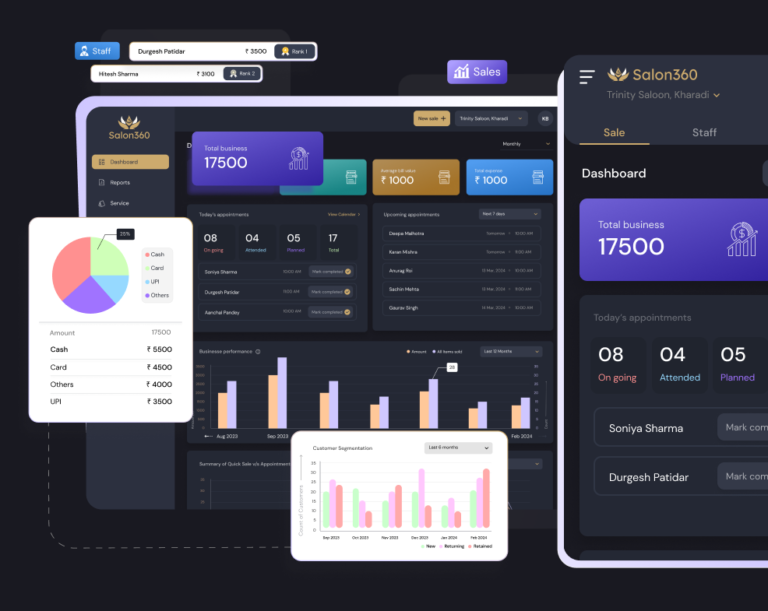
The best way to stay compliant and ensure all your accounts are in place is by getting salon GST billing software like Salon360. It will help you update your pricing easily, and generate clear profit and loss reports.
For complete compliance guidance, get a free demo.
FAQs

What is the GST rate applicable to salon services in India in 2026?
The current GST rate for salon services in India is 5%. On 22nd September 2025, the rate was reduced from 18% to 5% without input tax credit. The 5% GST rate is applicable to haircuts, hair colouring, facials, makeup, pedicures and manicures.
Is GST Registration Mandatory for all Salon Owners?
No. GST registration is not mandatory for all salon owners. It only becomes mandatory when the annual turnover exceeds Rs. 20 lakhs in most states and Rs. 10 lakhs in certain special category states.
Can Salon Owners Claim Input Tax Credit?
Under the revised 5% GST slab, salon owners cannot claim input tax credit on services. However, since salon retail products are still taxed at 18%, ITC can be claimed. However, mixed service and retail cases need a separate review.
What Records should a Salon Owner Maintain?
A salon owner should maintain records of appointments, invoices, daily revenue summaries, bank statements, GST filings and accounting records.
Should Salons use GST Billing Software?
Manual billing is error-prone and inefficient. By using salon GST billing software, salon owners can separate service and retail sales. Also, GST calculation is automated which saves time and makes return filing easy and hassle-free.